Business Briefings
Dangote Targets 20,000MW Power Expansion, Defends $20bn Refinery Project

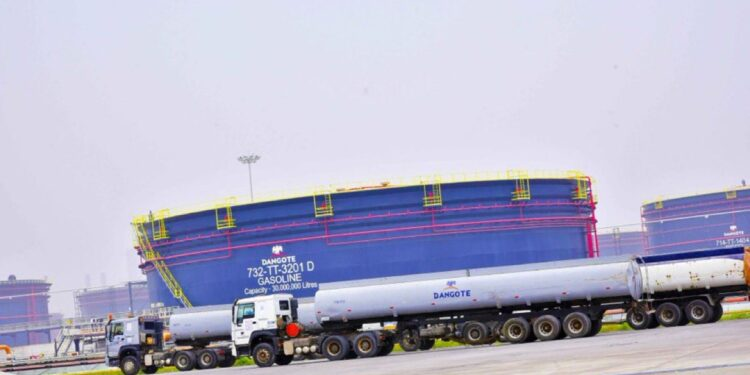
Africa’s richest businessman, Aliko Dangote, has outlined plans to expand into 20,000 megawatts of power generation while defending his $20 billion refinery project as evidence that large-scale industrial ventures are achievable in Africa.
Dangote made the disclosure during a podcast hosted by the Managing Director of the International Finance Corporation, Makhtar Diop, where he highlighted ongoing investments across energy, infrastructure, and industrial sectors aimed at addressing Africa’s development gaps.
He said the motivation for the refinery project stemmed from Nigeria’s heavy reliance on imported petroleum products despite being a major crude oil producer. According to him, this structural imbalance informed his decision to invest in domestic refining capacity.
Dangote stated that Nigeria previously exported large volumes of crude oil without local refining capacity, resulting in full dependence on imported refined products. He said, “At one point, we were exporting 2.4 million barrels per day and not processing even one barrel. Every single product we used, gasoline, jet fuel, everything was imported. I said no, this cannot continue.”
He confirmed that the refinery has now reached operational stability, processing crude at near full capacity. He said, “Today, we have tested the refinery up to 661,000 barrels per day, and for the last two months, we have been stable at 650,000 barrels per day. Every single department is working.”
The industrialist noted that the project has helped shift perceptions about Africa’s ability to execute complex industrial infrastructure. He said, “People always said this refinery will never happen. But today, we have shown that as an African company, we can deliver. That gives us a voice to tell others, come and invest in Africa.”
Dangote explained that the refinery was developed through an in-house engineering, procurement, and construction system, describing it as a fully self-executed project. He said, “We established our own EPC system. Every single nut and bolt we bought, we shipped, and we assembled.”
He added that the scale of the project required significant risk-taking, noting that he had no prior experience in crude oil operations before embarking on the investment.
Beyond refining, Dangote disclosed that his group is now focusing on addressing Africa’s infrastructure deficit, with particular emphasis on power generation, logistics, and industrial production. He said the company is targeting 20,000MW of electricity generation capacity as part of its expansion strategy.
He said, “We are now going into power, 20,000 megawatts. We are building the biggest deep-sea port, and we are doing LNG. Why? Because we are looking at the needs of Africa and making them a reality.”
Dangote emphasised that electricity supply remains a critical barrier to industrialisation across the continent. He noted that without reliable power, manufacturing and large-scale production would remain constrained.
He also linked his investments in fertiliser and agriculture to broader economic transformation goals, stating that the group aims to produce up to 12 million tonnes of urea, positioning it among the largest fertiliser producers globally.
He said, “For me, what gives satisfaction is how to take our continent out of trouble. We cannot continue importing what we consume. We must produce, we must add value.”
On intra-African trade, Dangote raised concerns about regulatory and logistical barriers limiting the free movement of goods and services across the continent. He described existing visa and border restrictions as major obstacles to investment and trade expansion.
He said, “Today, I need about 38 visas to move around Africa. How do you invest like that? You cannot even move goods from Lagos to Benin without spending weeks at the border. There is no way trade can work like this.”
He further noted that high transportation and logistics costs within Africa remain significantly higher than international shipping routes, which undermines competitiveness and regional integration efforts.
Dangote stated that his African Renaissance initiative aims to mobilise private sector investors to address infrastructure gaps and advocate policy reforms across African markets. He emphasised that private investment is essential for driving sustainable economic transformation.
He said, “If I don’t invest my own money, I cannot go anywhere and convince others to invest. But now we have demonstrated that these things are possible.”
He also disclosed plans to list parts of his business empire, including the refinery, to broaden African participation in ownership and wealth creation. According to him, such listings would allow Africans to benefit directly from dividends and investment returns.
He said, “We want Africans to invest. When we list, we will make sure dividends are paid in dollars. This will inject billions of dollars into the hands of Africans and change lives.”
Dangote reiterated that Africa’s development will depend on sustained investment in energy, agriculture, and infrastructure, rather than reliance on imports and external financing. He stressed the need for practical execution over theoretical policy discussions.
He said, “We don’t need theory. What we need is action. If we invest in Africa, if we open up Africa, we will create prosperity for our people.”
The planned expansion into large-scale power generation is expected to have significant implications for Nigeria’s industrial capacity, particularly if the 20,000MW target is achieved. It could help address chronic electricity shortages and support broader manufacturing growth.
The refinery project is also expected to reduce Nigeria’s dependence on imported refined petroleum products, conserve foreign exchange, and stabilise the downstream petroleum sector. Combined with planned energy investments, the initiatives could reshape the country’s industrial and economic landscape over the coming years.