Business Briefings
FG Launches Multilingual Toolkits to Boost AfCFTA Participation
The Federal Government has introduced simplified multilingual toolkits aimed at strengthening Nigeria’s participation in the African Continental Free Trade Area, with a focus on easing trade procedures and expanding non oil export opportunities.
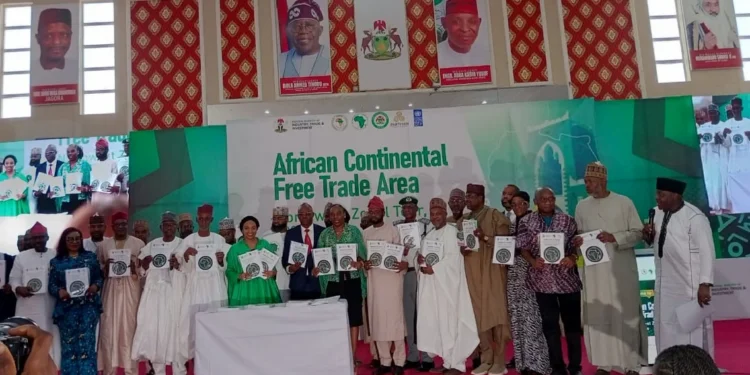
The Minister of Industry Trade and Investment Jumoke Oduwole unveiled the initiative in Kano during a subnational engagement on AfCFTA implementation. She described the move as a deliberate effort to translate policy into practical tools that businesses across Nigeria can easily understand and use.
According to the minister, the toolkits which are available in English Arabic and Hausa are designed to simplify complex trade requirements including rules of origin customs processes standards compliance and market entry procedures.
“We are simplifying trade for Nigerians and making it more accessible to businesses of all sizes,” Oduwole said. “The objective is to remove complexity and allow more people to take advantage of opportunities across Africa.”
Read Also:
- Afreximbank Launches $10bn Crisis Fund to Shield Africa and Caribbean from Iran Conflict
- Nigeria to Host 2027 Intra-African Trade Fair
She explained that many small and medium enterprises have struggled to participate fully in cross border trade due to complicated documentation and lack of awareness. By breaking down technical requirements into user friendly formats the government aims to bridge this gap and improve participation.
“We want to move from policy to action and ensure that trade becomes practical and immediate for Nigerian businesses,” she added.
To support the rollout the government is also deploying regulatory agencies to provide services such as business registration product certification and issuance of certificates of origin. These efforts are expected to reduce delays and improve compliance with export standards.
In addition to documentation support the initiative includes practical training programmes such as live export simulations and hands on sessions for businesses. These activities are designed to give participants real world exposure to export processes and improve their readiness for international trade.
A key component of the programme is the introduction of the One Local Government One Export Product initiative which aims to drive grassroots participation in export activities.
“We want every local government to identify at least one product it can export to Africa,” Oduwole said. “This will create opportunities at the grassroots and ensure that no region is left out of the trade ecosystem.”
She also highlighted recent progress under AfCFTA including the launch of an air cargo corridor that has significantly reduced freight costs on selected African routes.
“We have seen a reduction of up to seventy five per cent in logistics costs which is helping Nigerian products become more competitive,” she noted. “Demand for Nigerian goods such as food textiles and processed items is increasing across African markets.”
Nigeria’s role in the continental trade framework has been further strengthened by its selection as a pilot country for the Simplified Trade Regime in West Africa. The framework is designed to make cross border trade easier for small scale traders by reducing documentation requirements and lowering transaction costs.
Spokesperson of the Nigeria Customs Service Abdullahi Maiwada said supporting small traders is critical to unlocking the full benefits of AfCFTA.
“Simplified procedures will reduce transaction costs and improve access to markets across the region,” he said.
At the subnational level Kano State reaffirmed its readiness to leverage the opportunities created by the agreement. Governor Abba Kabir Yusuf represented by the Secretary to the State Government said the state is positioning itself as a major hub for trade and industrial activity.
“AfCFTA must work for traders processors youths and industries and we are committed to making that happen,” he said.
Despite the progress stakeholders acknowledge that utilisation of AfCFTA remains low among smaller exporters. Industry data shows that while non oil exports are growing many micro exporters are yet to fully benefit from the agreement.
This gap highlights the importance of initiatives such as the newly launched toolkits which are expected to improve awareness build capacity and expand participation across Nigeria’s business community.