
News
Jet fuel hits N1,800/litre as Nigerian Airlines battle rising costs

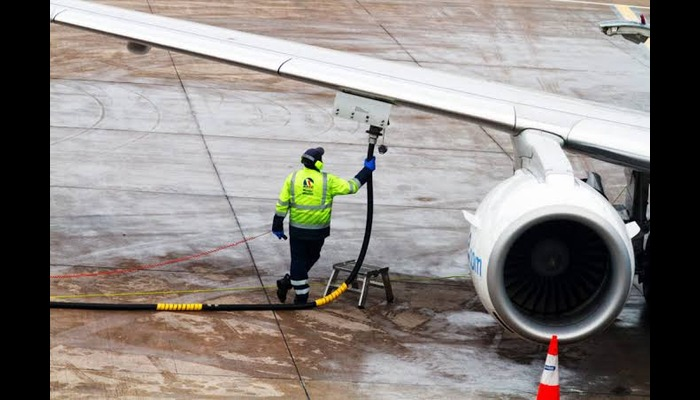
Domestic airline operators in Nigeria are grappling with mounting financial pressure following a sharp surge in aviation fuel prices, which has climbed to nearly N1,800 per litre in the wake of escalating tensions involving Iran, Israel and the United States.
Despite a slight retreat in global crude oil prices from earlier highs, the local cost of Jet A1 fuel has spiked dramatically within days, rising from about N900 per litre recorded on February 28 to between N1,803.19 and N1,852.19 per litre across major Nigerian airports.
Industry data shows that aviation fuel currently sells at about N1,803.19 per litre at the Murtala Muhammed International Airport, N1,839.19 at the Nnamdi Azikiwe International Airport and N1,852.19 per litre at the Mallam Aminu Kano International Airport.
The sudden price jump has left domestic airlines struggling to maintain operational stability while attempting to shield passengers from immediate fare increases.
Read Also:
- Global Energy, Trade Stability Under Pressure, IMF Warns
- CNG Stations Rollout Lags 2025 Target Despite $2bn Investment
Aviation experts warn that the surge in jet fuel prices could significantly disrupt airline cost structures, potentially triggering higher ticket fares in the coming weeks.
An aviation expert, John Ojikutu, explained that fuel typically accounts for about 40 percent of an airline’s total operational costs. However, with the current price surge, that figure could climb to nearly 70 percent, placing significant strain on operators.
“There’s no way the increase in fuel price will not affect airfare. Fuel is about 40 percent of the operational cost. If an airline is buying fuel at an increased cost, you can be sure that operational cost is going to increase by that amount,” Ojikutu said.
According to him, airlines have limited flexibility to renegotiate fixed expenses such as landing charges, navigation fees and other regulatory costs, forcing operators to seek alternative ways to manage the financial burden.
Airlines may adopt tiered fare adjustments
Rather than implementing across-the-board fare increases, Ojikutu said airlines are likely to adopt a tiered pricing strategy to spread the impact of rising fuel costs.
Under such an approach, premium passengers travelling in business and first class cabins could see ticket prices rise by between 20 percent and 30 percent.
Travellers purchasing tickets close to their departure dates may face steeper increases of up to 50 percent, while airlines may attempt to keep fare increases for early-booking economy passengers to around 10 percent in order to sustain demand.
Ojikutu added that airlines may also introduce internal cost-saving measures, including deploying aircraft with lower fuel consumption for similar routes and trimming onboard services.
“What I suggest is that airlines will look for aircraft that consume less fuel for the same distance and do some arithmetic internally. If they are serving food two or three times, they may probably reduce it,” he said.
Airlines operating at a loss
Meanwhile, the spokesperson for the Airline Operators of Nigeria, Obiora Okonkwo, described the current jet fuel price as “astronomical”, warning that many airlines are already operating at a loss.
Speaking during a recent television appearance, Okonkwo noted that aviation fuel now accounts for between 40 percent and 50 percent of the total operating costs of Nigerian airlines.
He explained that the price spike comes at a particularly difficult period for the industry, which typically experiences a sharp decline in passenger traffic after the peak December travel season.
According to him, passenger demand usually falls by between 40 percent and 60 percent during this period, making it difficult for airlines to immediately transfer rising costs to consumers.
“We are absorbing that extra cost right now for the interest of Nigerian travellers,” Okonkwo said.
“Any operator that is carrying 40, 60, or 70 percent passenger load is carrying you at a loss.”
Structural challenges compound pressure
Beyond fuel costs, airline operators say several structural issues continue to undermine the financial sustainability of the industry.
Okonkwo highlighted high borrowing costs as a major constraint, noting that Nigerian airlines face bank interest rates of about 30 percent, compared with between two and five percent for international competitors.
He also cited the burden of multiple levies, stating that local operators contend with more than 40 different taxes and charges imposed by various government agencies.
In addition, currency volatility remains a major challenge for the sector, as airlines earn revenue in naira while most critical expenses—including aircraft acquisition, maintenance and leasing—are denominated in US dollars.
Call for government intervention
To prevent a potential collapse of the domestic aviation industry, the airline operators are urging the Federal Government to introduce targeted policy support.
Okonkwo suggested that authorities could facilitate a supply arrangement with the Dangote Refinery to provide crude oil at preferential rates, which could enable the refinery to offer aviation fuel at a more affordable and stable price.
The group is also advocating the creation of a dedicated financial intervention window that would allow airlines to access single-digit interest loans to support aircraft acquisition and operational sustainability.
“Not free money, not a grant,” Okonkwo clarified. “But a single-digit loan for us to have access to for acquisitions and other operations. That would go a long way in reducing the financial pressure we are feeling.”
While international carriers have already begun adjusting their financial outlooks for 2026 amid uncertainties in the Middle East, Nigerian airlines remain in a cautious holding position, hoping that aviation fuel prices will stabilise before the current pressure becomes unsustainable.