Features
GLNG Funding SPV Raises N7.5 Billion in Latest Commercial Paper Issue

Nigeria’s GLNG Funding SPV PLC has re‑entered the nation’s short‑term capital markets with the offer of up to N7.5 billion in Series 4 Commercial Paper, marking its third issuance under an established N30 billion Commercial Paper Programme. The move comes as part of a wider trend of energy‑sector financing in Nigeria, combining corporate debt strategy with investor appetite for yield in a higher‑rate environment.
The offer, which opened on February 13, 2026, is scheduled to close on Friday, February 20, 2026. It follows two successful prior commercial paper issuances — Series 1 in July 2025, which was oversubscribed by 3%, and Series 2 & 3 in December 2025, which attracted 11% oversubscription from investors.
The Series 4 commercial paper is structured with a 364‑day tenor and carries a discount rate of 19.3651% per annum, translating to an implied annual yield of 24.00%. Settlement is planned for Monday, February 23, 2026, with maturity due on Monday, February 22, 2027. Minimum subscription is set at N5 million, with additional subscriptions allowed in multiples of N1,000 thereafter. Applicable taxes will be levied unless exemptions apply.
Read Also:
- FG Pledges Extra Funding to Launch Africa Energy Bank
- S&P Upgrades AFC to ‘A’, Boosting Infrastructure Funding Prospects
The issuance is listed for quotation on the FMDQ Securities Exchange Limited.
Issuer and Co‑Obligors: GLNG Funding SPV PLC is a special purpose vehicle (SPV) established to raise capital through debt instruments on behalf of its sponsors — Green Liquified Natural Gas Limited (GLNG) and Green Fuels Limited (GFL). Both entities operate within Nigeria’s industrial gas and energy value chain.
Green Fuels Limited (incorporated 2007) is a prominent player in the compressed natural gas (CNG) market and operates the largest CNG compression and distribution facility in Nigeria, with an installed capacity of approximately 17.5 million standard cubic feet per day (mmscfd). From its operational bases in Ota and Abeokuta, Ogun State, GFL serves a portfolio of multinational and blue‑chip industrial clients, including Nestlé Nigeria, Nigerian Breweries (Heineken), Cadbury, Guinness, Nigerian Bottling Company, Fan Milk Plc, Comcraft Group, Intercontinental Hotel, Island Power Ltd, Sumal Foods Ltd, Crown Ceramics Ltd, and Tosett Agro.
On the other hand, Green Liquified Natural Gas Limited (established in 2018) focuses on supplying power and clean energy solutions, including off‑grid power to industrial clients. GLNG has already delivered 40 MW of off‑grid power capacity and is planning to expand into LNG liquefaction, targeting the development of a 200,000 scm/day facility in Abeokuta, with phased expansion to 400,000 scm/day.
Both sponsors operate in competitive segments of Nigeria’s gas market, contending with rivals such as Powergas, NIPCO Gas, Greenville LNG, Bridport Energy, Axxela, and Tetracore within CNG distribution and broader gas supply services.
Debt Capital Market Track Record: The Series 4 commercial paper offer builds on GLNG Funding SPV’s established presence in Nigeria’s debt capital market. The group’s track record includes a series of institutional bond transactions dating back to 2022:
- A N650 million private company bond in 2022 with a 14% coupon.
- A N5 billion 10‑year Guaranteed Fixed Rate Series I Bond (due 2033) in 2023 at 15.2% coupon.
- A N12 billion 10‑year Guaranteed Fixed Rate Series II Bond (due 2035) in 2025.
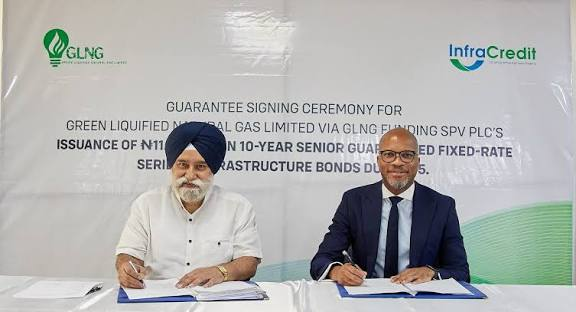
These issuances were credit‑enhanced by InfraCredit — Nigeria’s credit‑enhancement and risk‑mitigation institution — and were primarily subscribed to by institutional investors including pension fund administrators, insurance companies, and asset managers.
The strong subscription rates on prior commercial paper tranches reflect robust domestic demand among institutional investors for short‑term paper offering attractive yields in a tightening interest rate environment.
Use of Proceeds and Repayment Source: The proceeds from the Series 4 commercial paper are earmarked to support the sponsors’ short‑term working capital and funding requirements. This aligns with the structured nature of commercial paper as a bridge financing tool, allowing firms to manage liquidity and operational cash flow needs over a near‑term horizon.
Repayment of the paper is backed by the operating cash flows of the co‑obligors, rather than external guarantees or collateral. This cash‑flow‑backed structure places emphasis on the financial performance and credit strength of GLNG and GFL.
An investor considering the paper would weigh the implied 24% yield against operational performance indicators of the sponsors, particularly as they relate to cash flow generation.
GFL’s earnings engine has shown remarkable growth. In 2024, revenue from the compressed natural gas business surged 194% to N24.38 billion, up from N8.30 billion in 2023, while profit after tax jumped 431% to N6.18 billion from N1.16 billion. This performance demonstrates strong market demand and operational execution.
GLNG also recorded solid performance metrics, with revenue rising about 32% to N6.47 billion in 2024 from N4.90 billion in 2023. Meanwhile, profit after tax increased more than fourfold to N479 million from N88 million.
However, a notable contrast emerges in cash flow dynamics. Despite strong earnings growth, GLNG’s operating cash flow turned negative at around N504 million in 2024, compared with a positive N1.81 billion in 2023. The deterioration was driven by a sharp build‑up in working capital, particularly trade receivables — which expanded significantly as the company financed growth ahead of cash collections. Inventory and other working capital components also absorbed cash, and increases in payables were insufficient to balance the outflows.
By contrast, GFL generated strong positive operating cash flows, helping support liquidity at the group level. Even so, GLNG’s cash strain required the group to lean more heavily on financing activities, with higher net inflows from financing helping to keep year‑end cash balances broadly stable.
This context explains why the Series 4 commercial paper programme is positioned primarily as a working capital support tool, rather than purely as strategic expansion financing.
Investors evaluating the Series 4 commercial paper will focus on several key variables:
Cash Conversion Efficiency: The ability of GLNG to convert rising earnings into cash within the 364‑day duration of the paper will be critical for repayment confidence. Working capital discipline, particularly in managing receivables and inventories, will be central to achieving positive operating cash flows in the paper’s lifespan.
Yield vs. Risk: At an implied annual yield of 24%, the paper offers a risk‑adjusted return higher than many short‑term instruments in Nigeria’s capital markets, particularly against risk‑free rates. This yield premium reflects liquidity risk, credit risk, and market conditions.
Credit Ratings: The co‑obligors hold investment‑grade short‑term ratings from DataPro (A1/A2), which underscores the essential nature of the sponsors’ gas and power services, stable customer base, and institutional revenue streams.
Sector Outlook: The broader gas and energy sector in Nigeria remains strategically important given ongoing industrial demand, energy diversification efforts, and macroeconomic focus on domestic energy solutions.
Nigeria’s debt capital market continues to evolve as institutional investors seek instruments that balance yield, credit quality, and duration. Commercial paper programmes, particularly those with successful issuance histories like GLNG Funding SPV’s, contribute to liquidity and yield‑curve development in the short‑term debt market.
Investors have shown robust interest in prior Series 1–3 issuances, reflecting both confidence in the sponsors and appetite for structured corporate paper amid tight monetary policy conditions.
At the same time, corporate Nigeria’s reliance on short‑term financing for working capital underscores broader structural issues — including delayed receivables, supply chain financing needs, and currency‑linked cost pressures.
With settlement due on February 23, 2026, market participants will closely monitor subscription trends, pricing dynamics, and yield spreads relative to competing instruments. The maturity of the Series 4 paper on February 22, 2027, will test the sponsors’ ability to sustain cash flow performance through the commercial paper cycle.
For GLNG Funding SPV and its co‑obligors, the 2026 issuance represents both a continuation of its capital markets strategy and a barometer of investor confidence in Nigeria’s energy and industrial sectors.
At the broader level, the transaction reflects an active institutional debt market, where structured instruments backed by corporate cash flows — rather than tangible collateral — are increasingly leveraged to support operational financing and working capital requirements.