Features
How FAAC Allocations Defined State Budgets in 2025

Nigeria’s fiscal architecture places the Federation Account Allocation Committee (FAAC) at the heart of revenue distribution across the three tiers of government. In 2025, FAAC once again served as the principal conduit through which federally collected revenues—largely from oil, gas, taxes, and customs—were shared among the federal government, the 36 states, and local governments.
An examination of cumulative FAAC allocations for the 2025 fiscal year, based on monthly communiqués issued through the Office of the Accountant-General of the Federation, reveals a familiar but instructive pattern: oil-producing states and large commercial centres dominated the upper end of the revenue table, while structurally weaker states remained heavily dependent on statutory transfers.
This analysis aggregates monthly FAAC disbursements to states over the full year to identify the top recipients and explain the structural forces behind their positioning.
Understanding FAAC and Its Role in State Finances: FAAC distributes revenues from the Federation Account, which pools earnings from crude oil sales, petroleum profit tax, company income tax, customs and excise duties, value-added tax (VAT), electronic money transfer levy (EMTL), and other federally collected revenues. For most states, FAAC allocations account for between 60 and 90 per cent of total public revenue. Internally generated revenue (IGR) remains limited outside a handful of states, making FAAC the single most important determinant of fiscal capacity, budget execution, and debt sustainability at the subnational level. In 2025, FAAC distributions reflected a combination of factors, including fluctuations in global oil prices, production levels and pipeline security, exchange-rate dynamics, growth in VAT and electronic transaction volumes, and statutory derivation payments to oil-producing states.
Read Also:
- FG Sells N219.38bn Crude to Dangote Refinery in Four Months
- Nigerian Fintech Sector Expanded by 70% in 2025 – CBN
The Top Allocation Earners: What the Numbers Show: When monthly FAAC allocations are aggregated over the year, a clear hierarchy emerges.
Delta State topped the list, reflecting its status as one of Nigeria’s largest oil-producing states. Its revenue profile benefited significantly from the 13 per cent derivation fund, in addition to statutory allocations and VAT proceeds, bringing its cumulative FAAC allocation to ₦649.67 billion.
Rivers State followed closely, supported by oil production, gas-related activities, and strong VAT inflows tied to industrial and port-based economic activity. Its total allocation for the year reached ₦526.30 billion. Lagos State, despite not being an oil producer, ranked among the highest recipients due to its dominance in VAT generation and consumption-driven taxes, consistently accounting for a substantial share of national VAT collections. Lagos’s cumulative allocation was ₦514.56 billion.
Akwa Ibom and Bayelsa rounded out the top five, both buoyed by derivation revenues and oil-linked inflows that continue to shape fiscal outcomes in the Niger Delta. Akwa Ibom received ₦494.23 billion, while Bayelsa garnered ₦488.08 billion over the year. Beyond the top five, Kano State emerged as the leading non-oil northern state, reflecting population-based allocation weights and steady VAT receipts from commercial activity, with a cumulative allocation of ₦270.86 billion.
Oyo, Anambra, Borno, and Ondo completed the top ten, each benefiting from a mix of statutory allocations, VAT sharing, and, in Ondo’s case, derivation revenue. Oyo’s total was ₦213.75 billion, Anambra received ₦199.88 billion, Borno had ₦198.75 billion, and Ondo’s allocation amounted to ₦198.42 billion.

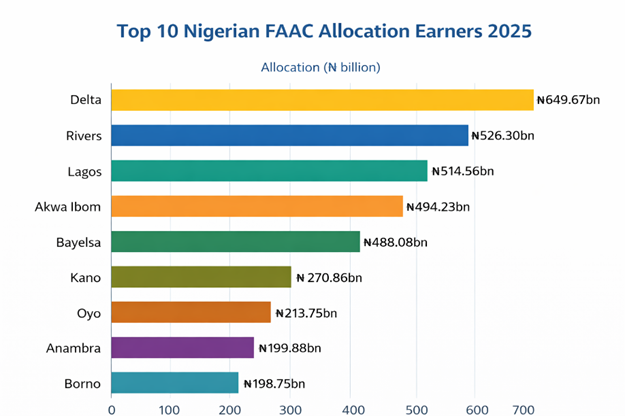
Why Oil-Producing States Still Dominate: The continued dominance of oil-producing states is primarily driven by the constitutional 13 per cent derivation principle. This provision ensures that states where natural resources are extracted receive an additional share of revenues derived from those resources.
In practice, derivation payments significantly amplify total FAAC receipts for Niger Delta states, often exceeding what they receive from core statutory allocations. In years of relatively stable oil output and favourable exchange rates, derivation can account for a substantial portion of state revenues.
In 2025, while oil production faced intermittent disruptions, improved pipeline security in certain corridors and exchange-rate adjustments helped sustain naira-denominated inflows to the Federation Account.
Lagos State’s consistent presence among the top FAAC recipients underscores the growing importance of consumption-based taxation in Nigeria’s revenue mix.
VAT collections have expanded in recent years due to higher transaction volumes, increased digital payments, and improved tax administration.
Although VAT is centrally collected, its redistribution formula ensures that economically active states benefit disproportionately. Lagos, as Nigeria’s commercial hub, captures a large share of VAT inflows, which bolsters its FAAC receipts even in the absence of oil derivation.
This dynamic highlights a gradual shift in Nigeria’s fiscal structure, where non-oil revenue sources—particularly VAT and EMTL—are playing a more visible role in shaping intergovernmental transfers.
Northern states, particularly those without significant IGR bases, rely heavily on population-weighted statutory allocations. Kano’s position in the top ten reflects its demographic weight and commercial activity, while other northern states rank lower due to weaker VAT generation and the absence of derivation revenue.
This raises ongoing policy debates around fiscal equity, population metrics, and the sustainability of subnational finances in states with limited economic diversification.
What the Rankings Reveal About Fiscal Structure: The 2025 FAAC allocation pattern reinforces several long-standing realities:
Resource location still matters: Oil-producing states retain a structural advantage due to derivation payments.
Economic activity is increasingly influential: States with strong consumption, trade, and financial services activity benefit more from VAT redistribution.
Fiscal dependence remains widespread: Many states continue to depend almost entirely on FAAC for recurrent expenditure, leaving them vulnerable to revenue shocks.
IGR disparities are widening:While some states are expanding internally generated revenue, others remain stagnant, deepening fiscal inequality.
Implications for Budgeting and Debt: High FAAC receipts do not automatically translate into fiscal strength. Several of the top-receiving states continue to face challenges, including rising debt service obligations, large wage bills, and gaps in infrastructure financing. In many cases, FAAC inflows are primarily used to cover recurrent expenditures rather than long-term capital investment. On the other hand, states with lower allocations but stronger fiscal discipline often achieve better development outcomes despite having fewer resources. This underscores the importance of distinguishing between revenue volume and fiscal effectiveness.
Transparency in FAAC reporting is maintained through monthly communiqués that detail disbursements to each tier of government. The federal government does not issue a single annual ranking of states by allocation. Annual analyses, such as this, are derived by aggregating the official monthly figures. Although methodologies can vary slightly depending on how supplementary distributions or timing differences are treated, the underlying data comes from the same authoritative source.
The 2025 FAAC outcomes also raise critical policy questions for the future. Should the derivation formula be revisited to support diversification goals? How can growth in VAT and other non-oil revenues be sustained without creating regressive tax burdens? What measures can incentivize states to expand their internally generated revenue and reduce dependence on federal transfers? Finally, how can FAAC inflows be more closely linked to development outcomes rather than just recurrent expenditure? These questions are central to Nigeria’s broader fiscal reform agenda.
The distribution of FAAC revenues in 2025 paints a clear picture of Nigeria’s fiscal realities. Oil-producing states and major economic centres continue to command the largest shares of federally distributed revenue, while many states remain structurally dependent on statutory transfers.
While the rankings themselves are informative, their deeper value lies in what they reveal about Nigeria’s revenue architecture, regional economic disparities, and the urgent need for subnational fiscal reform.
As the country continues to pursue economic diversification and fiscal sustainability, the FAAC framework—and how states respond to it—will remain a defining factor in Nigeria’s development trajectory.uted revenue, while many states remain structurally dependent on statutory transfers.
While the rankings themselves are informative, their deeper value lies in what they reveal about Nigeria’s revenue architecture, regional economic disparities, and the urgent need for subnational fiscal reform.
As the country continues to pursue economic diversification and fiscal sustainability, the FAAC framework—and how states respond to it—will remain a defining factor in Nigeria’s development trajectory.
-
OneDosh Raises Funding, Accelerates Global Expansion

OneDosh has secured an additional $1 million in pre-seed funding, increasing its total pre-seed capital to $4 million as it accelerates efforts to build a global borderless financial infrastructure platform. The company said the latest funding follows strong growth momentum, including expansion into 29 European markets, a user base that has surpassed 200,000, and the…
-
Flutterwave Pushes Africa Financial Operating Vision

Flutterwave Founder and Chief Executive Officer, Olugbenga Agboola, has outlined an ambitious vision to position the company as the foundational financial operating system powering Africa’s next phase of digital and cross-border economic growth. Speaking at Money 20/20 Europe in Amsterdam, Agboola said stablecoins represent a major upgrade to Africa’s payment infrastructure, particularly in enabling faster…
-
US Inflation Rises to 4.2% as Energy Prices Jump
US consumer inflation climbed to a fresh three-year peak in May, driven largely by rising energy costs linked to global supply disruptions, according to official data released by the Bureau of Labor Statistics. The Consumer Price Index (CPI) increased by 4.2 percent year-on-year, rising from April’s 3.8 percent, marking the highest level recorded since April…


